
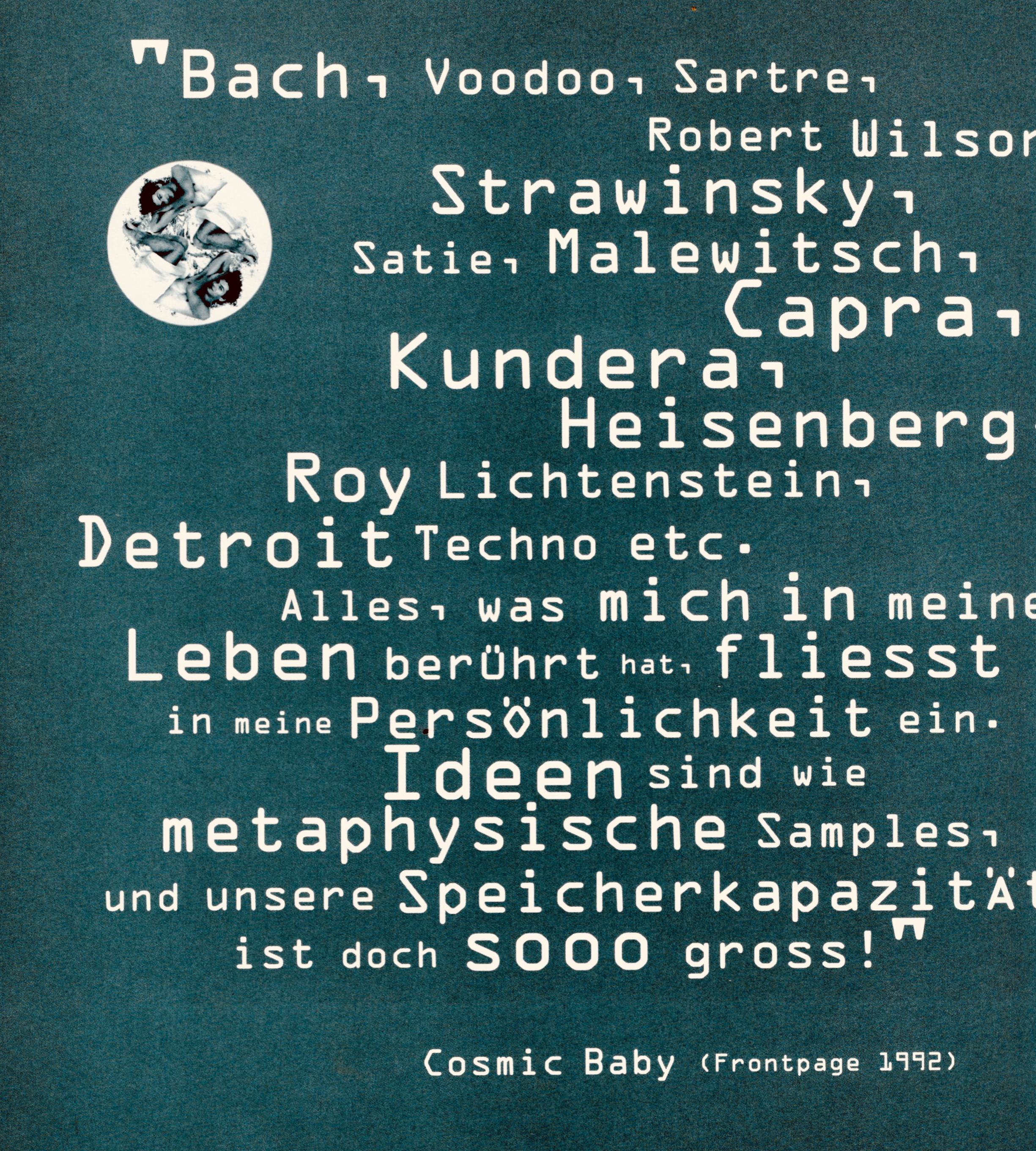
“I’m a mer person,” Cosmic Baby once said. So
water is the best place to talk to him.
Unfortunately, Zurich still can’t afford a sea, but
has a magnificent lake that makes life a lot
better. Cosmic Baby certainly liked it. Although
there are no dolphins leaping on the horizon, the ducks are chattering
instead. With his slightly
crumpled outfit, Cosmic Baby is the prototypical “artist”: a little
unworldly, but likeable at first glance. The women
love him, and the men still can’t manage to hate him.
Cosmic Baby is an intelligent conversationalist, he is
successful and popular. And if life really were a long,
calm river, then this story would already be
over here. But water is an unpredictable element that can be calm
and contemplative, but also tearing and destructive.
Like life.
Born in 1966, Cosmic Baby
discovered the piano at the age of three. At the age of seven, he was taken to the Nuremberg Conservatory
and gave his first solo concert at the age of eleven. A career
as a classical concert pianist would seem to be a foregone conclusion if
electronic music didn’t shake up his musical world view.
Cosmic Teen discovers Kraftwerk, Tangerine Dream and above all
“Planet Rock” and with it his love of the rhythm
machine – because it “can tell stories and doesn’t need
voices or instruments to do so”. Cosmic wanted a
synthesizer for Christmas and got one.
“I never wanted to be an instrumentalist, I always wanted to tell
about what I experience. Actually, I’ve always been
an authentic soundtrack writer. I didn’t want to do anything funk-
tional, but rather give back to the world
in my own way what it gives me.”
The second turning point came in the fall of 1988.
Cosmic, who was now studying composition and sound engineering in Berlin, experienced his first acid house party. This decisive moment that gives him strength and energy, because he realizes, like so many others: There are others with the same ideas and preferences, I’m not alone. Cosmic Baby begins to set radio plays to music for WDR . Here he can do what he wants. Later, when techno began to seep into the dark cracks of cellars and halls,
his career as a live act also began to take off.
“In 1990 there were already a few live acts, but they had more of a
function as interval fillers. People went to the
toilet and were happy when the DJ finally
came back. It was never supposed to happen that
there was anything other than DJing. Of course, there was also
a certain arrogance on the part of the DJs, who already realized
that they were going to be the new big stars. When I played
live for the first time, the first ten minutes were extremely
strange. People were looking: firstly, there’s
someone there now, secondly, what is he going to do, thirdly, how is he going to do it
and fourthly, oh, that’s completely different music. But then
they really freaked out – and so did I. From then on, I knew
that playing live was really great.”
Trance (“the yin of techno”, ©osmic) began to overtake the dominant hardcore in 1992.
At this time, trance may have been a justifiable approach to taking a new direction
with calm elements and repetitive structures. And even today, a surface can still be something beautiful if it is used correctly and not just abused to build up and reduce tensions.
But in the course of general trancification, the ears have been plastered with so much kitsch, sweet harmonies and eternally similar sounds that today even the good originals are often denied access to the aural gallery because of the bad copy
.
Everybody`s Baby
But in 1992, the world as will and trance was still unimaginable
and Cosmic Baby was chosen as the king of the new style. After
his first maxi was released on Low Spirit,
moved to the Berlin label MFS, where the first album
“Stellar Supreme” was released in September 1992. The breakthrough comes raser
quickly. Cosmic played at Mayday and was constantly on the road: “lt
was totally thrilled and overwhelmed that so many people listened to my
music and liked it too. The interest of the
media grew and grew. I noticed that the sir
really enjoyed talking to me and – naive as I was
– put this down to the fact that they liked me because I had interesting
things to say. I did a lot during that time
I threw myself into everything and wasn’t particularly selective
I played twice every weekend in two
different cities, almost like a DJ.” Many people around him warn him
not to take his great interest as an expression of affection
. But he pays little attention to it. During this time i
Cosmic everybody’s baby. At the beginning of 1993, he was at the top of
all the annual polls. “Heaven’s Tears” becomes a hit
as do his productions with Kid Paul (Energy 52), Paul van Dyk
(Visions Of Shiva) and Jonzon (Futurhythm/Vein Melter). He is on
the way to becoming the first really big star of techno.
But life is not . . .
“In the beginning, I always had the feeling that I was becoming even more filled with energy and influences at every gig. But at some point I just felt drained. I came home to feeling absolutely empty instead of relaxed and enthusiastic.
At theend, I was faced with a choice: either everything becomes a rout-
ed show, where you end up holding on to the keyboard and
only thinking about when you’re going to bed and when your flight to the next city is leaving. Or you stay true to yourself in the idea that what you love doing most, namely
music, is something extremely beautiful and therefore every evening and
every song should be something special.”
Anyone who has ever seen Cosmic Baby live knows what a gig
means to him. He sweats and screams, is constantly in con-
tact with the audience and sometimes gets on the keyboard. He
adapts his program to the mood of the moment, and his
classical training naturally comes in handy. A total show, which is not a show because he is completely absorbed in the music and the party. Cosmic realizes that he can’t pull this off.
He, the sensitive one who actually wants to approach everyone openly, realizes that he can’t blindly trust everyone who smiles at him. He tries to take a look behind the facade of the business. What he sees scares him, he could lose all desire and spirit. Cosmic goes through a depressive phase at and becomes increasingly ill. In mid-1993 he pulls the emergency brake: “I had the courage to come to terms with myself and what was happening around me.”
He reduced the live appearances to one per month and got himself a manager to take care of the contracts and contacts. During this phase, MFS also switched to Logic Records, the sub-label of a major label. MFS then faced an uncertain future. Cosmic Baby draws the consequences from this and, according to his own statements, negotiates a
contract with Logic that gives him complete artistic freedom – “every A&R or manager has a heart attack at”. The first release on Logic is “Loops Of Infinity”, a hard-trancer that ripples along shallowly and infinitely, but which is probably precisely why it enters the German charts – and is not wrongly dismissed by “Spex” as an “ass-commercial Euro album number”.
Forget the time
The criticism is now crashing over Cosmic Baby like a tidal wave.
Although he always affirms that he wrote “Loops Of Infinity” before the label
change and without looking at the charts,
the track makes him a symbol of selling out.
Although other Berlin DJs and acts have actually helped techno reach unimagined
and many unwanted commercial heights – and although he doesn’t give exclusive interviews to “Bravo”, isn’t on MTV every day and constantly refuses to play huge raves.
But he doesn’t have an empire. But he doesn’t have an empire behind him.
“After ‘Loops Of Infinity’ at the latest, everyone was able to bang on without
punishment. Nobody in the scene took it as badly as
me to release with a big record company.
I want to go a different way than all the major artists
like Sven Väth or others. But I got all that crap from
. But I don’t have a problem with that, because I see it more as a
compliment that people react to me emotionally in every respect
, both positively and negatively. I love it
to be controversial than a shining light who lives unreflectively.
I’m happy when I sell a lot, but I make sure I plan my music accordingly beforehand.
The advantage I have is that I’ll certainly still be making music in thirty years’ time.
I have plenty of time to develop further and keep learning new things.”
This difficult phase is reflected in the album “Thinking
About Myself”, which is released in spring 1994 and, in
contrast to “Stellar Supreme”, is characterized by melancholy. The
very personal album faithfully follows the principle: “When I make an
album, I try to portray the state in which I find myself
as complexly as possible.” Cosmic turns
again increasingly to the piano, his old love, which runs very deep.
When he watches the movie “The Piano” by Jane Campion,
he has to cry through the whole performance and can’t utter a word for hours afterwards.
The instrument and music on “Thinking About Myself” serve to purify himself: “In the studio
I swore the image of the ‘very young Cosmic): Playing the piano,
reflecting on and transferring what I had experienced, forgetting time, playing
les from my soul.
I deliberately forgot about the músic making, which now also means: promotion, contracts, audience response, sales figures,” explained Cosmic Baby in the magazine “Groove”. And in the liner notes to the album, he writes: “Music is a dream state materialized in sounds, and
‘ft I don’t wake up for days and nights.”
Art on the building
Cosmic is all about emotions. He never speaks of himself as an act
‘the producer, but as a techno artist and as such
on need, vocation and vision. He was particularly fascinated by
the Bauhaus movement, when people from all over the world and from all
art disciplines did research together. Cosmic Baby has built up his own little Bauhaus, a circle of creative people
. But his vision goes further: “The Bauhaus concept
still makes so much sense to me that I wish we
could create something similar in a new form. Techno is made all over the
world, and everyone can participate and define their
form. Communication between artists still works pretty smoothly
. Not via managers
or record companies, anyone can call anyone, or you can meet
at a rave. The globally networked culture is therefore already
there. What doesn’t exist is a stronger engagement, communication, networking with areas that have nothing to do with a bass drum in the first place.
Techno should be seen as a culture and not just as a dance event.
Of course, as in any other movement, there is so much diversity, and usually the arithmetic mean, the boring, rises so high that mediocrity is then equated with
the whole. I wonder how one could manage to represent a more complicated spectrum to the outside world. His collaboration with the Pyro Space Ballet and the result “Futura” can be seen in terms of this vision.
But somehow no new, revolutionary form wants to emerge from it. Cosmic Baby’s music relies on melodious sounds, conveys happiness and sadness, both beautiful, aesthetic feelings,
but never anger, the raw power of which can destroy music, but can also lead
into unexplored territories. Cosmic Baby is far too friendly and in tune with the world for that. So he is also allowed to spread his vision as a techno representative on ARD’s Kulturweltspiegel.
Perhaps one day Cosmic Baby will succeed in bringing life and aesthetics into harmonious vibrations that, as at the end of “Futura”, culminate in the creation of a
beautiful new world. And perhaps he will then see a glittering, calmly gliding river in the
mirror.
from Philipp Anz