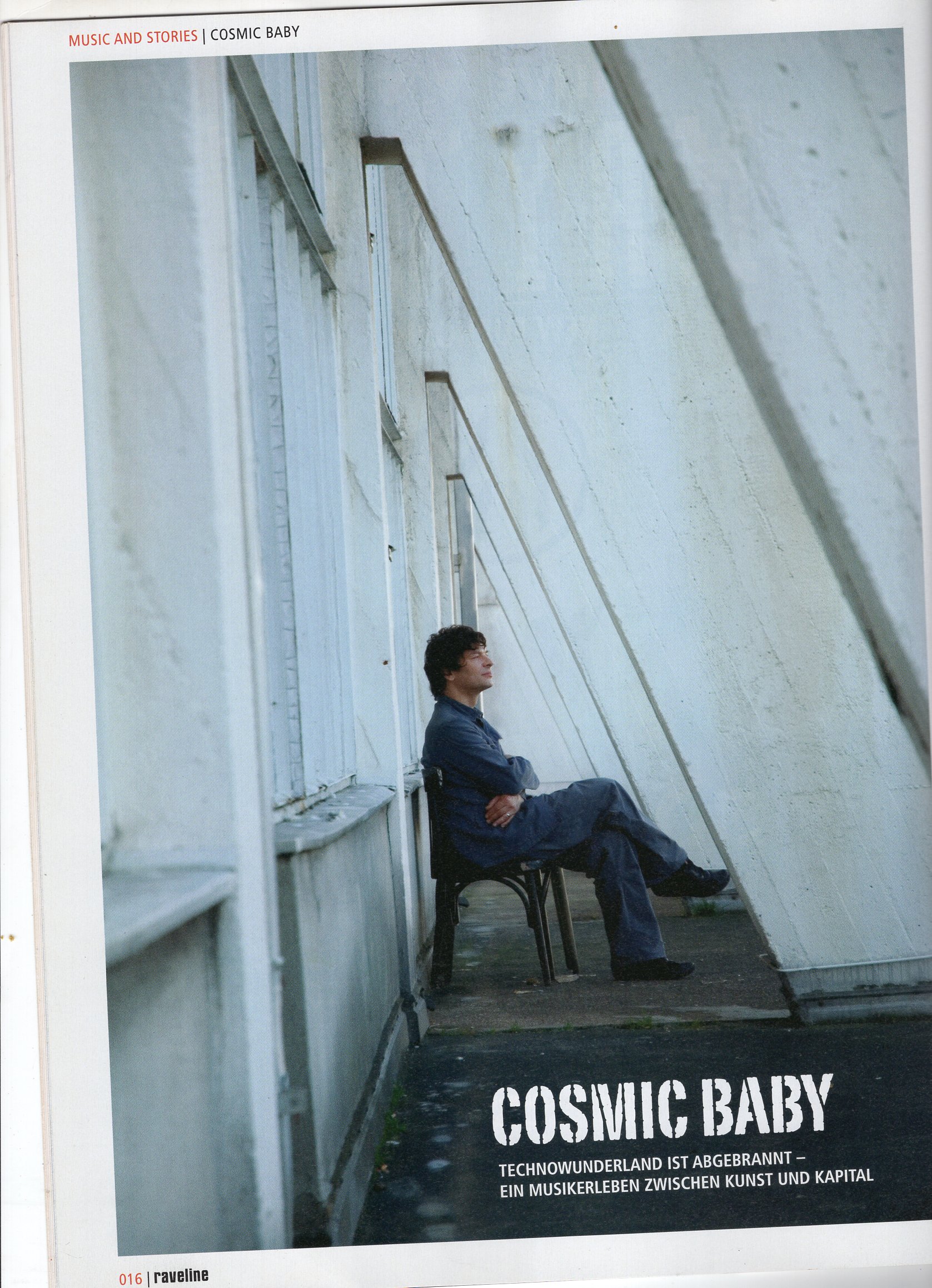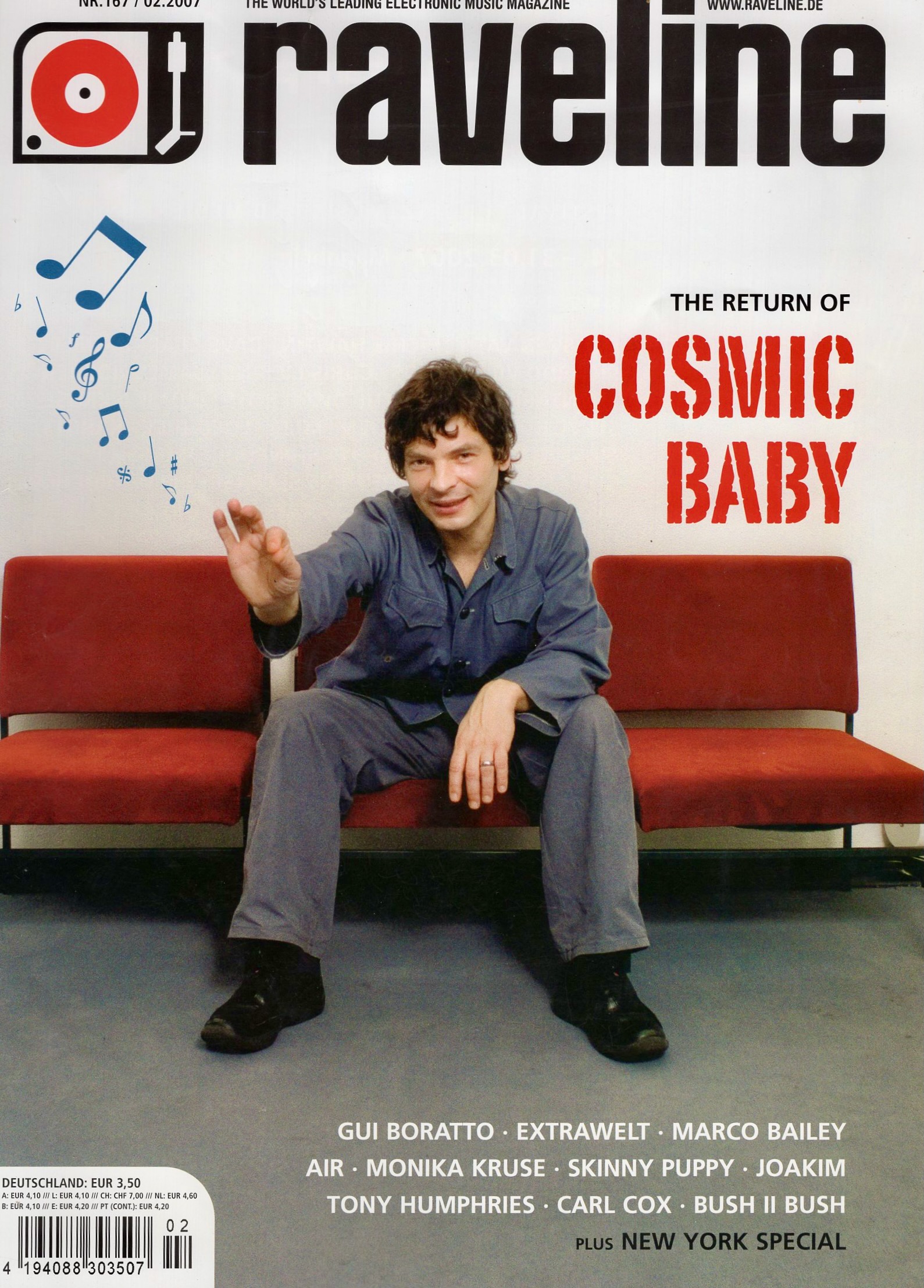
COSMIC BABY
TECHNOWUNDERLAND HAS BURNED DOWN –
A MUSICIAN’S LIFE BETWEEN ART AND CAPITAL
Harald Blüchel has written music history. He was an important part of the explosion of techno in Berlin, he was THE Protagonist of the trance scene, and he could write books about his worldwide concerts. At the height of his success, he broke away from everything and seemed to hide away in film and theater music. Now three different CDs are on the market, the early works have also been reissued, so it’s time for a comprehensive portrait.
Raveline: Reading your biography, the first thing one stumbles across is that you were awarded a gifted scholarship at the age of seven. That sounds like a musical prodigy…
Harald Blüchel : That was more of an early childhood passion. If you research the causes in artists’ biographies, you usually find that there was an early traumatic experience that was then compensated for artistically. In other words, you build up a parallel universe in which you get what you don’t get in real life.
Raveline: What did you have to compensate for as a child?
HB: (…) I felt like an outsider back then and had the feeling that the piano was the instrument with which I could express myself. What is then so beautifully called “highly gifted” is actually nothing more than a voluntary way of compensating for a dilemma.
Raveline: Even as a child, was music a positive form of escapism for you?
HB: Clearly. I would just be careful with the term escapism. That would mean escaping from the outside world. I always wanted to belong.
Raveline: I meant it more in the sense of children who build and furnish a cave in the forest to create their own world in the outside world. This cave seems to have been music for you.
HB: Definitely.
Raveline: At the age of fourteen you left the conservatory again, why?
HB: I had enough of classical music at first. And the motivation to build a hiding place then turned into a competitive sport at the conservatory. When it comes to being trained as a classical pianist, it’s all about parrying, discipline and perfection. From a purely technical point of view, I didn’t have the ability to become a super pianist. Even back then, I wanted to contribute myself, produce myself, not just reproduce.
Raveline: When you moved to Berlin in 1986 to start your studies, was there also the fascination of the big city for you?
HB: Yes, of course. I was fascinated by the concerts at SO 36 in Kreuzberg: Einstürzende Neubauten, Throbbing Gristle, Die Tödliche Doris. And Berlin was the closest acceptable big city to Nuremberg. But studying was just as important to me, I wanted to have as much freedom as possible in what I did. At the time, Berlin was the only city in Germany that offered music students the opportunity to work with a Fairlight (the prototype of all samplers, so to speak).
Raveline: One of your first musical partners was Jonzon. What were your first recording sessions like and are you still in contact today?
HB: I had already bought a few instruments at the end of the eighties, mainly older, inexpensive instruments that had just gone out of fashion, but with which you could make electronic music: the 808 and the 303 from Roland. At the time, I imagined my own music as an intersection between Afrika Bambaataa, Kraftwerk and Philip Glass. When I came to Berlin with these things, I heard a radio program by Monika Dietl, who was very interested in new electronic music at the time and was now enthusiastically playing acid house. It was completely different to anything I had heard in Bavaria. Monika Dietl brought me together with Jonzon. Jonzon was a drummer in a jazz-new wave band and was already playing acid house back then. He always came to me with samples from acid records and we made our own Chicago house tracks. There were no melodies; whenever something was just a little bit chordal, Jonzon would wave it off. So we sat there with five devices in an 18 square meter room and were happy like little kids when it grooved properly.
Raveline: After all, that led to a few Americans saying about you that you were the only Chicagoans from Europe…
HB: Yes, we were proud as punch. We still see each other from time to time. I’m sure we’ll make music together again at some point.
Raveline: Another early companion was Gabi Delgado of DAF and his partner Saba Komossa (together DelKom), who released your first record. According to your liner notes, you never saw any credit for it. Was that the case back then?
HB: (…)It was amazing for me that my idol Gabi Delgado was releasing a record of ours. He said at the time that he would rather start a new label than buy a new Porsche. Of course, we responded euphorically to that. And when we were told, “We think your music is so good that we want to have you on our music publishing company”, we signed all the contracts with wide-eyed excitement and looked forward to the first white labels. At the time, I ignored all the warnings from slightly older friends of mine, I thought it was downright outrageous that they found wording in the contract that was disadvantageous for us. I didn’t want to hear it and thought they were just trying to make me feel bad. But that’s exactly what happened…
Raveline: Do you regret that now?
HB: Nope. I learned a lot from it and I can’t be angry about it. I mean, the record was playing everywhere in the clubs and at the end of the year it was in Groove that it was one of the ten records of the year. What a start.
(…)
Raveline: You were at the first Love Parade and once said that the first four parades were the dream of wishes fulfilled, then you marveled from a distance at three parades, from the eighth parade you fled the city in disgust and since the 13th parade you’ve just been indifferent to the event. You already know Motte from the founding days at Turbine Rosenheim. What is your relationship like?
HB: The people who were in the Turbine or the Fischlabor back then – where I worked behind the bar with Tanith, by the way – those were the 150 people who were at the first parade. We met all the time: Tanith, Jonzon, Motte, Kid Paul and also WestBam. And it was never important who was actually playing records and who was dancing. And anyone who had made something new at home simply brought it along on cassette. That was an ideal pool. The idea of registering a demonstration, which is nothing more than a parade with our favorite music, fluttered around among us. And Motte was the one who happily took it into his own hands and said: “Let’s do it now!” He’s not the inventor of the Love Parade, but he was the one who made it happen. He then took care of everything with a few friends. By canceling his participation in 2006, he ultimately drew the same conclusions in his own way as I did in my own way a few years earlier.
Raveline: You’ve worked with a lot of people over the years, one of whom is now a real pop star, Paul van Dyk, with whom you had the Visions Of Shiva project. The small print on your website says that you’re surprised that Paul still doesn’t admit to not having contributed much to it back then. What happened back then?
HB: The Visions Of Shiva issue is a bit of a dilemma. At the time I didn’t say anything about what had happened, it looked like we were equal partners. Then I had moved so far away from techno that it didn’t really make sense to talk about it. And in the last few years, I thought to myself that if I started talking about it now, it would sound like Harald Blüchel, who had fallen short, was trying to get himself talked about again via the megastar Paul van Dyk. Now I’ve got to the point where I just want to say what it was like, because at least it has something to do with my authorship, for fuck’s sake. I mean, 150 people who hung out together back then all loved each other. In this euphoria of new beginnings, it really was like that, not just a slogan. It was the same with creative collaborations: there was a nice, very modest young man from Eisenhüttenstadt. With my half-GDR socialization, someone like that could only open doors for me. I know Eisenhüttenstadt, I have relatives there too. And this young man loves this music and says he wants to be there when this kind of music is created and he wants to play in the Tresor and so on. That was all very nice and flattered me. And when you think about this person while producing and then something great comes out of it, you have a feeling of connection and you think – even though it’s a Cosmic Baby song – that the record might help him get DJ gigs, after all we all belong together. That was the deciding factor: doing something together that wasn’t technically a joint effort.
(…)
Raveline: Someone you definitely like a lot more is Jam el Mar, then part of the duo Jam & Spoon. You wrote about him that he was a master that hardly anyone could hold a candle to. That sounds like comprehensive reverence.
HB: Yes, high praise from my colleagues.
Raveline: Did you have anything to do with Mark Spoon as well?
HB: Yes. From the very beginning, I had the feeling with Markus that if the circumstances were a little different – I don’t want to explain what circumstances could mean – then he could have become a very close friend of mine. Whenever we saw each other, there were moments when we were suddenly just the two of us, whether there was a lot of cheering or not. And there were longer moments when the two of us spent days together, discussing private matters in depth. That’s why he’s one of the few people from this scene who means a lot to me, who I’ve always seen as a companion.
Raveline: With Mijk van Dijk, you put together a compilation on MFS Records at the time (“Tranceformed from Beyond”) that reinvented something entirely, namely it functioned less as a mix CD and more as a remix record. You reworked all the tracks, sometimes to such an extent that only the essence remained. That was new and, from today’s perspective, groundbreaking. How did the idea come about and what connects you to Mijk?
HB: The idea came from label boss Mark Reeder. I would say that Mark, along with Monika Dietl, was the most important person at the very beginning because he had a lot to do with the East Berlin electronic music scene during the GDR era. And after November 1989, he immediately saw the opportunity to cooperate with Amiga (the GDR’s state record company – note) and set up a new label. I always liked people who had a plan and then tried to implement it – without thinking about whether it would pay off. Mark was a visionary. For me, it was an initial spark that someone said to me, “I think your music is great and I’ll give you the opportunity to release whatever you want on my label.” A great offer. His support encouraged me to go further, to experiment. Without someone like Mark, I would have been much more influenced by what I liked at the time, such as the Belgian R & S label. Mark chose Mijk because he thought we would go well together. Mijk is also one of the wonderful 150 people. We only lived a block apart and have very similar social backgrounds, are politically interested and culturally open-minded. That was also a good fit musically. Mijk is a very important companion.
Raveline: Was it also Mark’s idea to edit the individual tracks?
HB: Yes, Mark wanted an audio manifesto, which is what we want overall. To get to the heart of a part of the techno universe. Because we are musicians, we wanted to put this CD together like musicians. That suited me very well because I was already writing radio plays at the time, so I was used to approaching things dramaturgically.
Raveline: We haven’t yet mentioned an important companion: Kid Paul, with whom you produced the hit “Café del Mar” under the name Energy 52. The title is by far the most successful and best known of your career, “Café del Mar” is still THE key track of an entire music genre. Would you like to tell the story of this song again?
HB: Gladly. I met Kid Paul for the first time in 1989 at an acid house party. I was completely blown away by the kind of music a 13-year-old was playing. We got on well right from the start and our relationship quickly became a bit like two only children who had always wanted a brother. Not only did he like acid, he also had a soft spot for melodies, just like me, and we both had the same favorite song at the time: “Chimes” by Orbital. I met up with Jonzon maybe every two weeks back then, but I made music with Paul almost every day. He was excellent at analyzing music, explaining to me every detail of my music and why it worked on a dance floor. It became a permanent musical dialog. We also went out together, of course, and in 1990 we went to Ibiza together, where we got to know the now world-famous Café del Mar. A DJ played a mixture of psychedelic rock music, ambient, classical, Spanish music and techno in front of around 40 people, which absolutely thrilled us. We had found a place where – unlike in discos like Amnesia – there were only friendly people who we would have liked to talk to. We were there every night for two weeks. Paul kept going back to Ibiza later, but I never went back, I was afraid that I would be robbed of what I had seen there in those early days. In 1992, Paul came back from the island and said he had heard a song there that was absolutely brilliant. He played it for me on the keyboard and I then realized that it must be by Wim Mertens. It’s a track from the soundtrack of the Peter Greenaway film “The Architect’s Belly”. Paul really wanted to make something out of it and Wim Mertens was already one of my favorite composers at the time. We didn’t just want to produce a good piece on this basis, but we vowed quite pathetically not to stop until every detail was absolutely perfect.
Raveline: Does that mean you can actually say that “Café del Mar” is a cover version of “Struggle For Pleasure”?
HB: We wanted to make a wonderful piece, a tribute based on the inspiration of another piece that we admired and still admire with all our souls.
Raveline: The track was released as a white label by Sven Väth’s Eye-Q label at the time and then withdrawn again. It then took a very long time before the track was available, even though all the DJs played the white labels. Why was that?
HB: In our euphoria, it was enough for us that the piece was played. We could already make a living from our music, even if we were paid ridiculous amounts back then. For example, I once played in front of around 5,000 people and got 500 marks for it. You can count on two fingers what some promoters earned back then. But that wasn’t important. We could do what we wanted and make a living from it, that was the decisive factor. The fact that the deal with Eye-Q didn’t materialize was because we felt ignored. We had given them the track as a demo and we wanted to negotiate for it to be released at some point. And suddenly the white label was already there, which didn’t suit us. The people in Frankfurt simply knew more about the business than we did. I mean, I don’t always want to hide behind youthful naivety…
Raveline: After all, you were already thirty at the time…
HB: Exactly. The name Cosmic Baby actually says it all: with this combination of divine radiation and little child schema, I wanted to seal myself off again and not let anything get to me. A really fatal biographical mistake in my life: I thought I could achieve a self-identity on the basis of a musical form of expression. I wanted the person Harald Blüchel, whom I had actually denied, to transcend into the most beloved of all people, Cosmic Baby.
Raveline: What does “Energy 52” stand for?
HB: Quite simply for energy as a manifesto and 52 was Paul’s house number.
Raveline: Why were there no further releases of your collaboration after “Café del Mar”?
HB: That was because Paul left the whole scene shortly afterwards.
Raveline: “Café del Mar” was the peak of your success, you played at all the major events and raves, sometimes in front of more than 10,000 people. Was there anything left to come? Could you even take it all in?
HB: During this time, I had the dream of belonging to something that was new, growing bigger and changing the world. Something that would give me an identity, something for which I would receive recognition. By 1993 at the latest, all of this had absolutely come true. I became something of a leading figure, which was very flattering for me. Always flying business class, playing worldwide and if I wanted to, I could say I wanted to stay a week, look around and meet people. Everything I had dreamed of had developed in a fantastic way. A huge stroke of luck! I was able to preserve this state for a very long time. On the other hand, there were obvious contradictions. I wasn’t that unworldly not to realize in moments of distance that I wasn’t just a product of myself, but also always a product of the markets, media and slogans. However, I successfully managed to push these thoughts away for a very long time so that I could continue to hold on to this “beautiful world” state. At some point, a point was reached where the gap between desire/illusion and reality became too wide, or rather the – imagined – sovereignty turned out to be a dependency: I needed the constant resonance, the shouting, the confirmation. Whenever I took a break, something was missing. I needed this something that distracted me from seeing what else was inside me, this hidden, unloved personality of Harald Blüchel. For years I hadn’t even listened to my first name, everyone called me Cosmic. At some point, something had to change, everything came to a head in a conflict that I had to resolve with myself.
Raveline: Would you agree that you were a bit of a naive dreamer until the mid-nineties?
HB: Yes, I was always both: a skeptic, an outsider and a dreamer, but at the same time someone who could fascinate and inspire others. I wanted to experience happiness in life through the perfection of the naive dreamer, because I didn’t believe that I could endure it as a completely normal person.
Raveline: That brings us back to the motif of escapism. You said back in 1996: “I created a confectioner’s world out of romantic harmonies.” A perfect world?
HB: Yes, the original idea of Cosmic Baby is the beautiful ideal world.
Raveline: Earlier you touched on the discrepancies between appearance and reality, between internal and external perception, between the self and the other. If you feed these discrepancies, it leads to schizophrenia. How did you manage to ensure that two parallel strands did not diverge, but instead intersected? And can this be directly linked to your turning away from the techno scene?
HB: Turning away from the techno scene is a subconscious desire to resolve this schizophrenia. I tried to hold on to this schizophrenic state until it was no longer possible, until I could no longer successfully repress the fact that I wasn’t capable of having deeper human relationships over a longer period of time. You wish you could be a normal person, be stupid, look like shit and talk stupidly or make mistakes and at the same time you have the delusion of insisting on being something really great. This results in an inability to let yourself go and be honest with yourself and others. When you realize this, you have to make some very radical changes.
Raveline: Does that mean that the discrepancy between artist and art figure goes so far that it has affected your personal life a lot?
HB: Of course. Although I didn’t want to admit that for a long time.
Raveline: Reading your biography, this turn in the second half of the nineties away from electronic pop music towards more experimental music and, for example, founding your own label, looks like a desire to achieve artistic and material independence. In our conversation, it now seems more as if this turnaround was necessary in order not to go to the dogs psychologically.
HB: Exactly, that’s how it is. As I was still very fixated on the artistic figure, I naturally had to take these steps via the artistic identity.
Raveline: That means, for example, releasing a record under your real name.
HB: That’s right.
Raveline: You then made theater music for the first time in 1997 (for Max Frisch’s “Andorra”), composed film music and produced radio plays again. Was that a dualism, that on the one hand you were doing completely different things artistically and on the other hand you were able to massively advance this chosen path of finally finding yourself? So was artistic development also – to put it bluntly – self-healing?
HB: There were new challenges that were perfect for taking a different path and still getting validation. I can express myself fantastically in theater music, it offers completely new possibilities for making music. I can be inspired because I’m no longer working alone, but with 30 people.
Raveline: You announced various releases of sound recordings in 2001, but then withdrew them without comment. Was that the “Magic Mountain” trilogy?
HB: Yes. Also.
Raveline: Why take it back?
HB: Because ultimately I still found myself in the same trap: to “come back” with something new and perfect as quickly as possible. There was still an inner compulsion to want to “show” something. Only when I had thrown all fears of loss overboard and started to take the time to work on my self-image both as a normal person and as an artist, to analyze my position in the world and the system in which I find myself and to draw conclusions from this, was I able to build a new personal foundation step by step. This ultimately took seven years. Only now have I reached the point where I can present the work of the period from 1999 to 2005 with the “Zauberberg” trilogy and then arrive relaxed in the present. From this basis, I can also move into the future as a composer.
Raveline: Does that mean that it would be conceivable for current music by you to appear again from 2007?
HB: Yes, exactly. The third part of the trilogy is already finished. “Toteninsel” has just come out in the fall, “Caged” will be released in March and five months later the third part with the title “electric chamber music” will follow.
Raveline: You also just released the most recent Cosmic Baby record, which was made between 1997 and 1999. Will there be more Cosmic Baby records in the future or was this the last one under this name?
HB: For a while, it looked like I didn’t want to release any more as Cosmic Baby. But at the same time, I was always making some kind of electronic pop music – even if it was just for relaxation in between. Now I can say for myself that I no longer have this obsessive superego, I no longer have to live up to Cosmic Baby. It’s no longer my life to be Cosmic Baby. I can now see it as a form of expression, one of many.
Raveline: Will you split it from now on so that Cosmic Baby is responsible for electronic pop music and Harald Blüchel does theater and film music and radio plays?
HB: That’s quite a useful definition. I can well imagine having a collection of pop pieces over a longer period of time at some point, which could then be a new Cosmic Baby record. But with a completely different motivation than what happened in the nineties. It would then no longer have anything to do with necessity.
Raveline: “Industrie und Melodie” has just been released. The record picks up on your penchant for electro, which already shines through on some of your records from ’95/’96. Compared to your early works, a common thread is still recognizable, but stylistically it no longer has much to do with them. Rather, “Industrie und Melodie” seems to be a Kraftwerk homage.
HB: Yes, it is. Looking back, the album is a continuation of “14 Pieces”. And a detailed search, so to speak, of “Heaven”, the official last Cosmic Baby album from 1998. Back then, I wanted to square the circle, namely to make a popular, chart-ready record that was at the same time completely different from what chart-ready records should be. It should cover everything I’m interested in musically. It should show that I am a techno pioneer, but at the same time I don’t want to have anything to do with techno anymore. I wanted to show it to people I always wanted to show it to, but at the same time I wanted to break away from these people. So it was a total overreach, a nonsense, an impossible concept.
Raveline: According to your liner notes, you see the concept as a failure….
HB: Yes, it was. That was already clear to me at the time
Raveline: You got a lot of bad press for this….
HB: Mostly for the wrong reasons, but not without good reason.
Raveline: I assume it still affected you because it was your most ambitious project to date.
HB: Yes, but I knew that it was just ambitious and failed precisely because of this super-ambition. The point was, I had thought about how Cosmic Baby could continue, after Trance, so to speak. One possibility was to reconsider and return to my high school idols: Kraftwerk and Tangerine Dream. And – not as well known, but just as important: people like Roedelius, Moebius, Cluster, Thomas Dinger and La Düsseldorf, Der Plan, DAF. All of that had a huge impact on me. I thought about that when I set up a workspace at home where there were only these old devices, i.e. only instruments from the seventies. Whenever I worked here, I had a lot of fun, which is why the pieces came about so wonderfully casually. And yet, at the same time, I forced myself to work on “Heaven” again and again.
Raveline: The two records are very different, it’s hard to imagine that they were created in parallel. Did you not release “Industrie und Melodie” back then because you were afraid that it wouldn’t live up to the high standards you had set with “Heaven”?
HB: Exactly. It was a paradox to be stuck in a phase where I perceived lightness, which is actually something you want, as worthlessness. And working hard on something unattainable was the challenge. It was like punishing myself. Suddenly, the only thing of value was what you had spent the most time on.
Raveline: So it took you years before you could also stand by an electropop record like “Industrie und Melodie”. Fortunately, the album is very timeless, perhaps because of the Kraftwerk references that extend from the cover design to the liner notes. It’s not really noticeable that the album is already around eight years old…
HB: Thank you, that’s the nicest thing I could hear about it. That’s how I feel about it too. It’s nice to hear it from someone else.
Raveline: Do you think that for people who are interested in electronic dance music, who are maybe in their early twenties now and consequently probably mostly unfamiliar with your old work, the album could be a gateway to the world of Cosmic Baby? In other words, is it suitable for discovering your music retrospectively?
HB: I don’t know. That’s not the reason why I’m releasing the record.
Raveline: Aren’t the threads that you recorded in the early nineties still being spun audibly here? So that there is a direct reference?
HB: Yes, I think that if you examine it closely, you can recognize what I always wanted electronically. For example, there are components that appear both there and on “Stellar Supreme”, albeit with a different sign. But the interesting thing is that the record sounds the way I would have liked it to sound in 1980 if I had had the instruments back then. Let’s assume I had been a few years older back then and lived in Düsseldorf, then it could well have been that I was playing with DAF or something. Or become the keyboarder for Fehlfarben. This kind of music that I’m celebrating couldn’t have been created back then because I was too young, but I listened to this music. And this music later became techno.
Raveline: Could you imagine following up on that musically now, seven to eight years later? To continue fulfilling the musical dreams of your youth?
HB: Yes, definitely. My meeting with Christopher von Deylen (from the Schiller project – note) put me in a position to make electronic pop music again in a relaxed way. As Christopher is also a big TD fan, we want to make a TD record together at some point, which Tangerine Dream unfortunately can no longer do…
Raveline: Were you at the TD concert recently?
HB: Yes, it’s bad. It’s like being a communist and then seeing that after ten years the party is no longer the one you actually want it to be. TD still has something really great for me in the constellation of the seventies and eighties. Everything that came after that I tried to listen to again and again with good will, but I didn’t like it.
Raveline: Would you agree when people say that your collaborations with Christopher von Deylen are midway between the works of Harald Blüchel and Cosmic Baby?
HB: I would rather say between Schiller and Cosmic Baby. Two private individuals are doing something different as their projects and yet are located in the same world. The approach was not to create an intersection, but rather that we both indulge in our shared passions. To do something that we would otherwise never be able to do on our own.
Raveline: Looking at your biography, you have always pursued many projects at the same time. It seems to me that there was a gap between 1999 and 2004. You did something here and there, but it still looks as if something else absorbed you or as if there was an artistic hole. Is that deceptive?
HB: That depends on how you define hole. If you see hole as failure, as a phase in which you have nothing to say, then it’s wrong. If you define a hole as being on the lookout, as a decision to do this in peace and not to expose yourself to any external pressure, then a hole is right. A hole is something you can look into, but it is dark and you don’t know where it ends and where it begins and what happens in it, when you would go down there. So the word hole makes perfect sense because I definitely didn’t know where it was going. I just knew it was good to go into that hole. Because there’s something in there that might let me come out at another point.
Raveline: Was that also the most withdrawn phase of your artistic life? Now that this phase seems to be over, is it fair to say that it was also a cathartic way of breaking free from old difficulties?
HB: Of course, Mr. Therapist. That’s probably true. But you shouldn’t forget that I’d already had twenty years to compose in my head before “Stellar Supreme” came out. Some people are amazed that an artist can compose a lot in two or three years and then suddenly compose very little or nothing at all. In the meantime, I have experienced this process myself. Kraftwerk is the best example of this – I don’t want to put myself on the same level as them – but it also took them fifteen years to bring out another piece. I can now understand how something like that can happen. I can also understand that artists who have become very successful with one thing have then disappointed their audience by doing something completely different. As an audience, I have also accused artists of that.
Raveline: You said in an interview that the majority of techno producers had come to a standstill, both humanly and artistically. You also said that the techno scene was at the “peak of an artistically shameful poverty” around 2001. As a result, the entire genre would eventually become questionable in the mass confection, because “its flood naturally washes away the few good examples.”
HB: Yes, that’s right.
Raveline: It sounds like there are at least a few current releases that you appreciate. But it also sounds like you think that the child called techno has fallen into the well and won’t crawl out again.
HB: Such statements show that I can obviously still get excited and am still interested in what is happening with techno. If I speak to you now for the Raveline forum, it means that I still see myself in there. I want to stimulate a discussion through polarization. In the meantime, I’m also happy to accept that I can be criticized for this. Like: ‘He’s got a good point, it was nice and easy back then and what he did wasn’t that new. – That’s all true. It wasn’t all better in the past. The important point for me is not to leave music, or more precisely “our” electronic music, standing in the room so value-free. The things I said there also have to be seen in context, namely that it’s not just in music, but that it’s a phenomenon that can be applied to all areas of our lives, our society, our system. Even if, like me, you define yourself artistically primarily through music, you are confronted with a very strong political factor in the world. And in my opinion, this is increasingly dissolving into complacent silence, deliberately “from above”. The discussion that I want to stimulate has a lot to do with the fact that I want to link music and the things that concern me socially.
Raveline: But what if young music producers who are successful right now today say to you, “Hey, when you were our age, you didn’t give a shit about that kind of thing either. Why should we do that now?” Isn’t it a characteristic of adults to think more outside the box than many young people?
HB: You’re absolutely right. Nevertheless. Firstly, despite all my naivety, I said a bit more about it back then than “I want to have a good party.” Secondly, I think it’s perfectly legitimate to say, “You do your thing and I’ll do mine. And don’t be any more know-it-all than you were at this stage.” But: it’s not just twenty-year-olds who read Raveline, but also people our age and I can address them. And there are certainly enough twenty-year-olds who could (well) understand that. Of course, we lived in the same system in 1989, experienced similar wars and similar propaganda. And yet things have become even worse. A twenty-year-old today will have to think a lot more about politics than we had to. Capitalism was neither globally dominant, nor was it able to show itself as barbarically unmasked as it does today.
Raveline: But haven’t all young people always had the feeling that things have never been as bad as they are now? Take the sixties with the Vietnam War and the student movements or think back to the eighties when people were afraid of SDI and the exploded Chernobyl led to doomsday moods.
HB: Of course, for every generation, its own time is the worst of all times. And it is always a challenge to get information about this world and to settle into it – however you do it.
Raveline: It’s easier to get information today than it was in the seventies, for example. On the other hand, it is always said that it is a privilege of young people to feel misunderstood, to rebel against the ruling systems and state governments or at least to disagree with current politics. But especially now that young people have many more opportunities to obtain information, it seems as if this is being used much less and far fewer consequences are being drawn from it.
HB: I see it very differently. I don’t believe that these possibilities exist. This seemingly limitless and free information tends to create the illusion of being informed. (…) Our media today seem to me like the GDR media back then, except that they are ostensibly freer and seemingly more diverse. In principle, it is even more perfidious to use half-truths, omissions, gossip, comedy and events “powered by” to distract from the fact that we have constant discourse that only takes place within the rules of the system, but in no way criticizes or attacks this system from the outside.
Raveline: Thinking further, does this bring us back to the time of the Enlightenment, when people who tried to turn people into much more mature beings ultimately failed because many people didn’t necessarily want that?
HB: That’s a secondary discourse. It is said that there are people who show initiative in taking control of their lives. And others who absolutely want to be in control. The primary discourse, however, would be that historically there has always been a small class of people who had capital and the means of production and a large number of people who didn’t and had to sell their labor in order to survive. This structure has continued to be perfected to this day. In today’s democracy, things used to look better: in the 1970s it was very social democratic, there was a social market economy, there was full employment, there were opportunities for advancement. Now the system says, as it did during the industrial revolution: “God-given, there are hard-working and less hard-working people, it’s a law of nature that people compete with each other.” We established earlier that every society always says it is living in the worst of times, so every ruling system says of itself: “We have never been better off than we are today.” There is always a layer of people who suggest to others that they are voluntarily doing what they are supposed to do. If someone says, I don’t really want to decide for myself, then I dare say it’s because this person has never been motivated to decide anything independently. Motivation always requires an offer, education and encouragement.
Raveline: In the liner notes of the second part of the Zauberberg trilogy, you painted a bleak picture of our society today, especially of the possibilities of the individual. Do you have any utopias or ideas on how to break out of this?
HB: For generations, we have been living with the lifelong lie that if taxes fall for entrepreneurs, there will be more work. But Karl Marx already pointed out in 1848 that this would not be the case. We have continued to develop this system, we have allowed ourselves to be bought into it. I have not painted a gloomy picture, but rather conveyed a realistic view of what it looks like.
Raveline: A small interjection: Isn’t it cynical to talk like that, even though you have profited from this capitalist system for years and have been able to fulfill dreams that you couldn’t have fulfilled outside of this system?
HB: A totally reactionary argument. Brecht was already accused of this when he got rich with The Threepenny Opera. It’s this bourgeois-liberal “agreed” feuilletonistic defensive struggle that we experience all the time. If someone presumes to get to the heart of something in a radically critical way, they are told they are a do-gooder, a do-gooder, a populist, a rhetorician. Or they’ll be told, ‘just take it easy, you’ve benefited the most from this. Or: ‘Since you’ve been unsuccessful, you’re opening your mouth again’. I can also be accused of using a wonderful advertising strategy: the critical Harald Blüchel. Of course, that’s how you can drive any kind of criticism against the wall.
Raveline: Back to utopia: what can young people do better within the grievances in which they live?
HB: How would it be if all these people who have been shelved and who are supposedly no longer needed, instead of indulging in drugs or television or the like, were quietly invisible, if they all took to the streets and met up once a week, e.g. on Ku’Damm, in front of KaDeWe and just stood around.
Raveline: There is such a thing in internet forums…
HB: Yes, but completely invisible. Everyone sits alone in front of their computer. If they all saw each other, it would be something completely different. Imagine if they kept coming back and it got bigger and bigger. They would disrupt the wonderful consumer world with their mere existence. Then something would happen.
Raveline: Back to the “Magic Mountain” trilogy: the two parts that have already been published are quite different from anything you’ve done before. “Toteninsel”, the first part, is inspired by a five-part painting series of the same name by Arnold Böcklin (important Swiss painter – note), which was created at the end of the 19th century. You use text passages from the Ausschwitz trials and weave them into relatively harmonious ambient sounds. Wouldn’t these texts have been better suited to the much darker and noisier second part?
HB: On the one hand, I didn’t want to use clichés and implement this theme musically, as you might expect. On the other hand, the first part is the first attempt to approach the subject at all. If you now have the feeling that the second part comes closer to it, then that’s exactly what I was hoping for, namely that I would get closer to a subject with a trilogy. The first part still sounds in part as if you could also find it on a Cosmic Baby album. Between 1999 and 2001, my first goal was to take stock. What are the possibilities that I already have and where can I start again in order to find a language that can really tell what I want to tell. The second part was more successful.
Raveline: Even though the term “Magic Mountain” appears in medieval stories, you can’t help but think of Thomas Mann’s novel of the same name. Was his “Magic Mountain” a direct source of inspiration?
HB: Yes, my trilogy is very much about that. There are three aspects that I would particularly emphasize. Firstly, Thomas Mann once said in his aloof, upper-class way about art: art is dilettantish as long as it only reflects one’s own sensitivities. For him, art is only meaningful or interesting when it is truly objectified. Which in a figurative sense means nothing other than that you get impulses from your own life – because you have nothing else to tell – but then try to put it into a larger context. The Cosmic Baby past was more a simple statement of conditions. ‘I’m sad, I’m melancholy, I’m happy, I want us all to be brothers’. I wanted to get there, to deal with it more abstractly. Secondly, in “The Magic Mountain” Thomas Mann manages to create a huge kaleidoscope of discourses, social contradictions, personal hopes, desires and sensitivities that correlate with one another. And not to say from the outset, ‘I see it this way and that’s why I’m writing it this way’, but he has tried to depict the different ways in which one can see the world in a novel. Thirdly: basically the image of the Magic Mountain as experienced by the patients in the novel: Outsiders looking down from above on a functioning world that may not be functioning all that well. The further away you get from this being-in-the-world, the more distance you get from what is happening down there, which can mean both criticism and alienation.
For me, it was about getting my feet on the ground, being able to endure something, not trying to resolve contradictions by suppressing one part and idealizing the other, but trying to live these contradictions and thereby become free as a personality. The “Magic Mountain” trilogy is based on these points.
Raveline: One big difference between the two parts that have already been released seems to me to be the move away from electronic instruments, which comes into play for the first time on the second part. You recorded everything acoustically and then edited and reassembled it on the computer. Is that a link to your youth, is “Caged” actually what you wanted to do as a teenager?
HB: Grotesquely enough, yes, I have some youthful works. One of them is called “Timeless” and is a 50-minute collage of piano, a few Orff sound instruments and a radio with two tape decks. The radio was my synthesizer replacement back then. I made it when I was about 17. I didn’t think about it when I recorded “Caged”, but if you listened to the two pieces side by side, you could tell that they were on different levels compositionally and sonically, but could well have been written by the same composer. That is frightening in one way, but also interesting in another. A lot has happened in the meantime; I can express myself more clearly now, but the handwriting is similar. I was recently at a graduation reunion, my first. Apart from my classmates, there were also some teachers there and one of them said to me – and teachers can judge that quite well – that I had actually remained the same. He didn’t mean that in the sense of “not having learned anything new”, but that some of the things that make up a person don’t change over decades.
Raveline: “Caged” reminded me of industrial music from the late seventies, bands like Throbbing Gristle, S.P.K. or Cabaret Voltaire. You mentioned earlier that you also listened to music like this in your youth. It also sounds like electronic music despite the instrumentation. Did you have the feeling that if you recorded a lot of acoustic instruments and then processed them, you would have more possibilities than if you had produced another record with electronic instruments?
HB: Yes, of course. For example, because the saxophonist is simply incredible, I hardly edited his parts, he can implement my ideas in a wonderful way. I got really close to him with the microphones so that I could also hear the body playing. An aspect that doesn’t happen with electronic music.
Raveline: And was it important to collaborate with other musicians?
HB: Definitely. It was a big step for me to say, I don’t want to sit here alone in the studio anymore, I want to do something together with others. That has a lot to do with theater music, where I was a musician on my own, but I found it very inspiring to work closely with others. I also wanted to learn a lot about what you can do with which instrument and where the limits are. I could also perform “Caged” live with acoustic instruments.
Raveline: Was Wim Mertens again the source of inspiration for “Caged”? On his great minimal work “Alle Dinghe” (yes, with an ‘h’ – note), he explored in a remarkable way all the sounds you can get out of a few acoustic instruments.
HB: Absolutely. Whereby Wim Mertens is clearly inspired by John Cage, who invented new compositional techniques. The title “Caged” is a play on words, which on the one hand refers to John Cage as an inspirer and on the other hand addresses the imprisonment of an individual. What I appreciate about Mertens is that he is able to say a lot and create an effect with just one instrument and very few soundtracks.
Raveline: How can we imagine the third part of the “Magic Mountain”, which you have already finished? Will it be acoustic again?
HB: No, the third part is called “Electric Chamber Music” and brings together a large number of short songs that were written in the period from 1999 to 2005. Small units that also try to do justice to a theme. As the name “Chamber Music” suggests, everything has very minimal structures, with only two or three instruments per piece.
Raveline: You once said that art, as distinct from an art product, builds up so much space that a micro-world can emerge. Can you explain that again, perhaps define what makes art art for you?
HB: Let’s take the critical approach that most of what is presented as art today is an art product. I would explain this by saying that today the market dictates what art should look like rather than what an artist wants to achieve from their own micro-world. Every artist wants to make a living from their art and be noticed, i.e. become public. Even if no artist here and now can claim that they have to fear censorship, their work is still very much measured by their success. What interests me about other people’s works of art is what does not immediately confirm me, what is not what I want to hear or see. I try to get involved with something and that can lead to me seeing the world a little bit with new eyes. Of course, this only happens when something new comes along and not when I get what I already like. This wish of mine can only be fulfilled by people who probably don’t give a damn whether it’s in demand or not. This means that someone doesn’t offer what they want to tell as a product, but as a personal micro-world that has the potential to give me inspiration for my own life. So it’s not about reflecting a person in a work, but something has to happen that is a little more abstract. I also believe that an artist who provides a microcosm at this time has to show his colors. He has to know exactly what he wants and what he doesn’t want. And what consequences he is prepared to endure.
Raveline: Is there any music from the last year or two that excites you?
HB: Sure, I think Röyksopp and especially Air are fantastic. The last record I bought was the album by Trentemøller. I really enjoy it, it makes me want to make electronic music again. Or the latest work by Peter Licht, my eyes light up. And Jeans Team! Super! Nevertheless, I see my artistic present and future less in popular music than in contemporary classical music.
Raveline: As Cosmic Baby, you co-founded an entire genre back in the day. Even after you left, trance continued to exist, and in recent years there seems to have been a resurgence in the scene. Are you still following this?
HB: No, actually not anymore… Nonsense, that’s not true! It’s like this: I’m still as happy as a snow king about great new electronic (pop) music! The fact that I still want to listen to new works by my companions and contemporaries a la Peter Kuhlmann, The Modernist, Aphex Twin or Future Sound of London immediately shows me that it still means a lot to me – just like the opposite, when I’m ashamed of mediocre or bad techno that I happen to hear. Electronic music and techno are part of my life story. A true communist may resign from the party or be kicked out, but he will always stand up for the world revolution J
Interview: Hauke Schlichting
Photos: Leif-Henrik Osthoff